MCRLab ECCV 2026 University of Ottawa

MedPhyGraph

Counterfactual Support-Graph Maintenance for Dynamic Built-Environment Digital Twins

MCRLab, School of Electrical Engineering and Computer Science,
University of Ottawa, Ottawa, Ontario, Canada

Paper Coming soon Code Model Dataset BibTeX
1.000Core Transfer Dyn-F1
0.998Expanded Transfer Dyn-F1
217Transfers / 19 templates
0Structural violations

Abstract

Dynamic digital twins must update semantic relations and geometry when objects change. We present MedPhyGraph, a framework for maintaining SupportedBy graphs across adjacent digital-twin states. CF-SupportNet scores candidate edges using static geometry and counterfactual evidence from analytic host-removal rollouts. Deterministic state and transition consistency enforce graph validity and identify supporter changes. MedPhyGraph operates downstream of perception on structured object states and requires neither ground-truth destinations nor transfer metadata at inference. We evaluate MedPhyGraph in controlled healthcare digital-twin environments realized and visualized using NVIDIA Isaac for Healthcare assets; these assets are not model inputs or label sources. Under the controlled core protocol, MedPhyGraph achieves Transition-Macro, Pooled Delta Micro, and Transfer Dyn-F1 of 1.000. Across 217 transfers and 19 semantic templates, it recovers all required transfer edges and reaches pooled Transfer Dyn-F1 of 0.998.

Pipeline

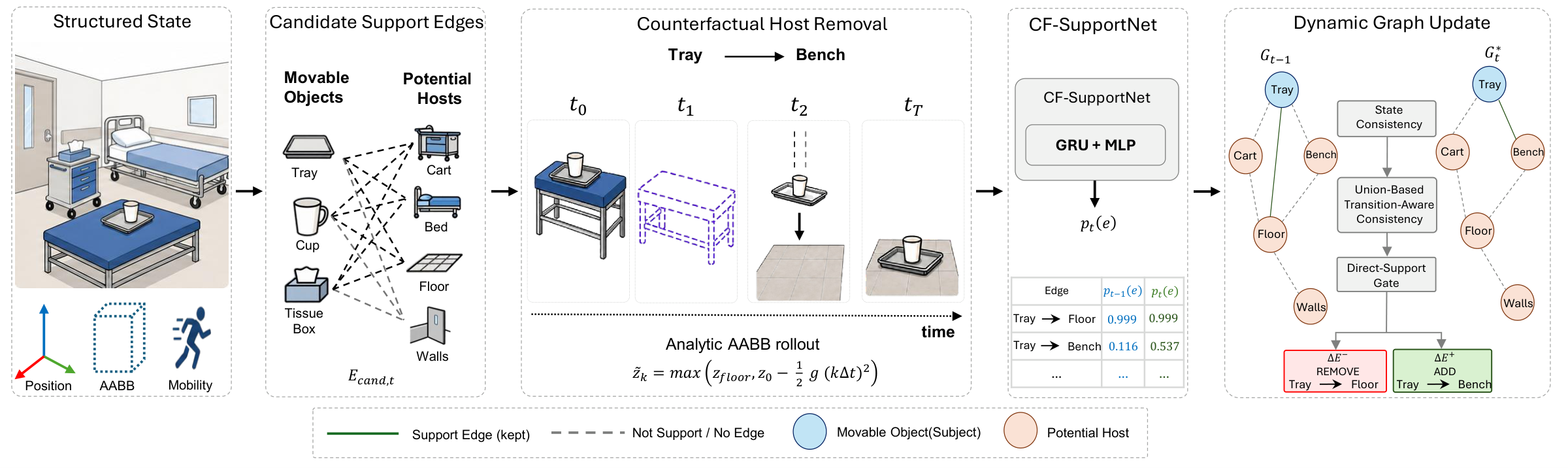
Candidate edges are scored by CF-SupportNet from static geometry and analytic AABB host-removal evidence. State Consistency and Union-Based Transition-Aware Consistency update the support graph across adjacent states.

MedPhyGraph pipeline overview from the paper
Figure 1. Overview of MedPhyGraph. Rendered images, ground-truth edges, operation labels, and authored transfer destinations are not used at inference. PDF
1

Candidate generation

Geometric and structural cues define a plausible subject–host search space without GT edges.

2

CF-SupportNet

GRU + geometry fusion scores each candidate from analytic host-removal trajectories.

3

Transition consistency

Dual-state scoring, previous-host decline, Direct-Support Gate, and graph refinement.

Demo

Isaac Sim clips visualize a tray support transfer in a healthcare digital-twin room. Renders are visual context only — not model inputs or training labels.

Isaac Sim — wide room view

Hero camera over the operating / procedure room layout while the tray moves from the cabinet area toward the side table beside the monitor cart.

Isaac Sim — transfer close-up

Demo camera focused on the support transfer: the tray leaves the previous host surface and settles on the destination support used by MedPhyGraph evaluation.

Support-graph update

Corresponding graph edit after transition-aware inference: remove the previous SupportedBy edge and add the new host relation for the transferred subject.

Results

Support-graph recovery and adjacent-state maintenance on Procedural Scenes and Isaac for Healthcare Scenes, with Isaac as the primary setting unless noted otherwise. Primary results use the frozen inference policy with observation ratio ρ=1.0 and seed 0.

1.000Transition-Macro Dyn-F1 (Isaac / Procedural core)
1.000Transfer Dyn-F1 (core protocol)
0.997±0.001Expanded Transfer Dyn-F1 (seeds 0–4)

Results on the expanded 217-case transfer suite

Required success indicates recovery of both required transfer edges; additional errors are reflected in the pooled metrics. Best and second-best results are highlighted.

Method Req. Success Transfer Add Remove
Geometry Rule 0.862 0.931 1.000 0.862
Logistic Regression 0.654 0.791 0.791 0.791
Random Forest 0.000 0.000 0.000 0.000
MLP 0.000 0.000 0.000 0.000
CF-SupportNet + SC 0.000 0.000 0.000 0.000
MedPhyGraph 1.000 0.998 1.000 0.995

Complete dynamic results on Isaac for Healthcare Scenes

Under the full transition operator and verified operation-consistent targets.

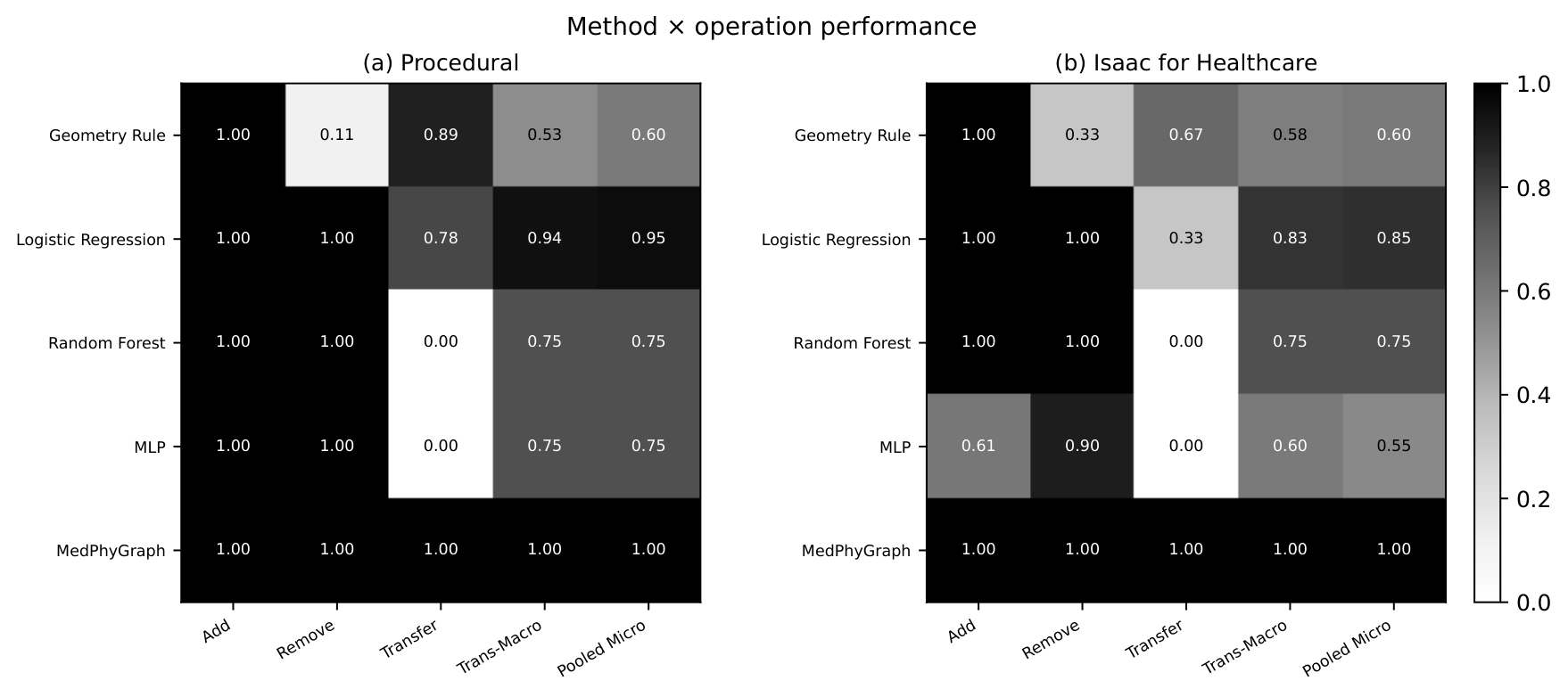
Method Trans-Macro Pooled Micro Add Remove Transfer
Geometry Rule 0.583 0.600 1.000 0.333 0.667
Logistic Regression 0.833 0.846 1.000 1.000 0.333
Random Forest 0.750 0.750 1.000 1.000 0.000
MLP 0.601 0.545 0.606 0.900 0.000
MedPhyGraph 1.000 1.000 1.000 1.000 1.000

Component analysis on Isaac for Healthcare Scenes under the core protocol

Viol.: mean structural violations; T-Mac.: Transition-Macro Dyn-F1. Best transfer results and the strongest partial configuration are highlighted.

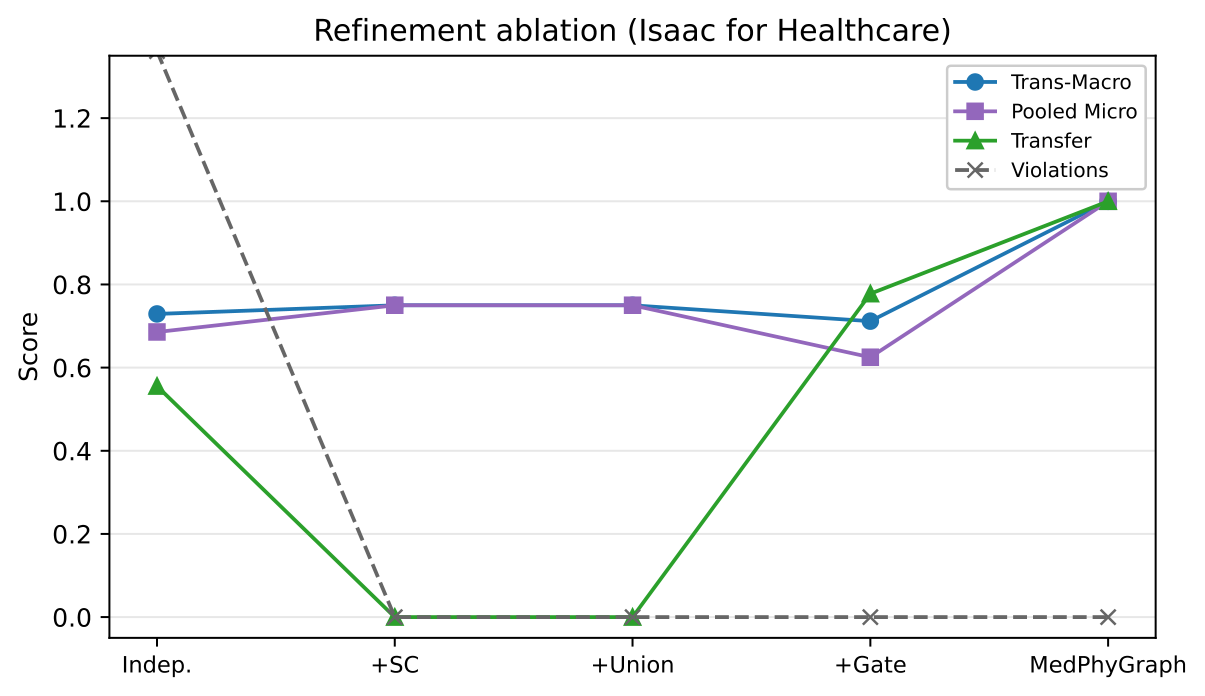
Configuration Viol. T-Mac. Transfer
Independent CF-SupportNet 1.361 0.729 0.556
+ State Consistency 0.000 0.750 0.000
Union rescoring only 0.000 0.750 0.000
Direct-Support Gate only 0.000 0.712 0.778
Union and Gate 0.000 0.750 0.000
MedPhyGraph 0.000 1.000 1.000

Figures

Method-by-operation dynamic performance on Procedural and Isaac for Healthcare Scenes
Figure 3. Method-by-operation dynamic performance on Procedural and Isaac for Healthcare Scenes under the core 60-transition protocol (15 eligible support transfers). Methods differ primarily on support transfer rather than ordinary addition or removal. Complete operation-level results are reported in the Supplementary Material. PDF
Isaac refinement analysis under the frozen core protocol
Figure S1. Isaac refinement analysis under the frozen core protocol. State Consistency removes structural violations, while complete transition-aware selection is required for reliable supporter replacement. Exact values are reported in the Supplementary Material. PDF
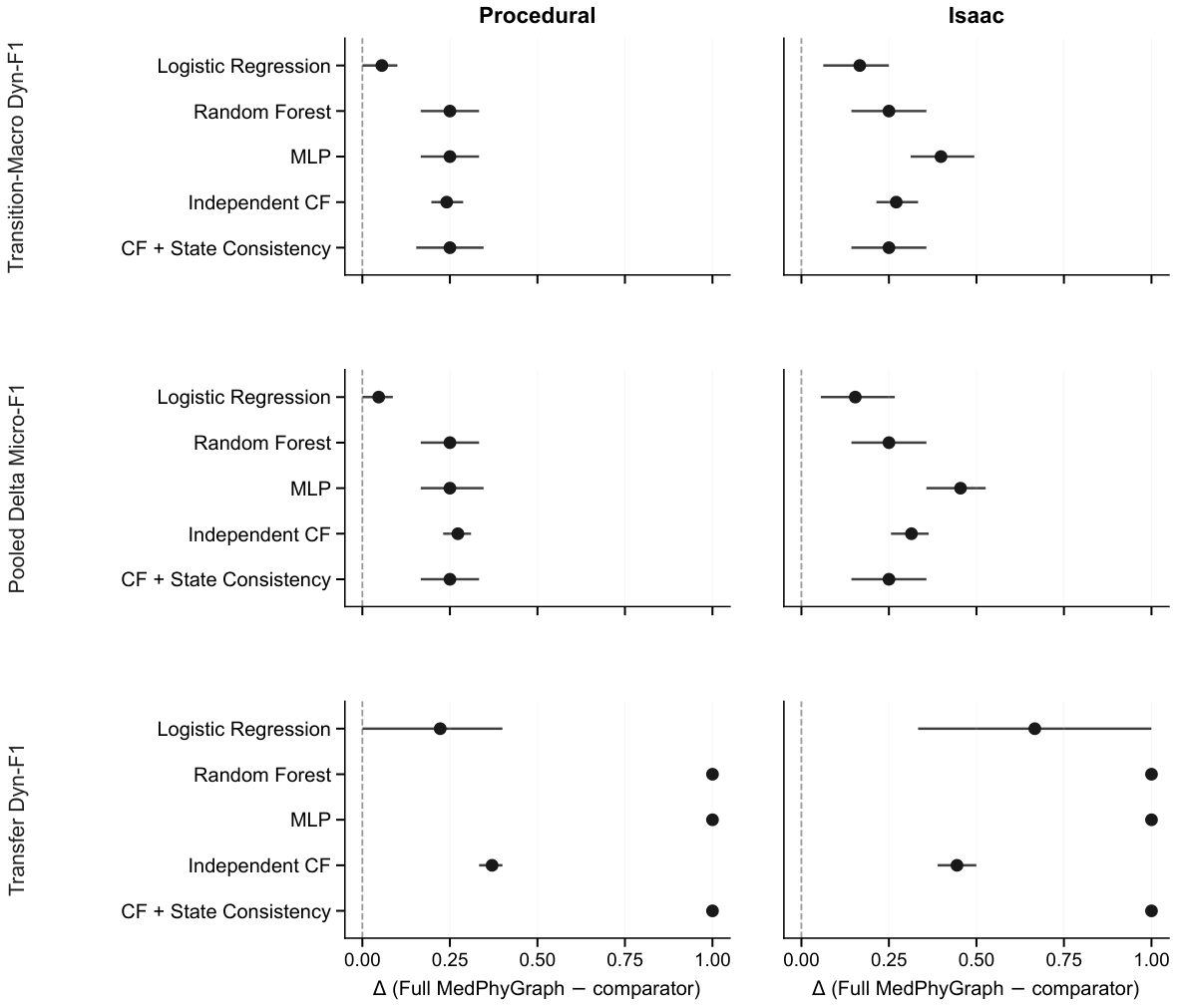
Paired bootstrap differences with 95 percent confidence intervals
Figure S2. Paired bootstrap differences (MedPhyGraph minus comparator) with 95% confidence intervals from 10,000 seed-0 replicates using base-scene resampling. Columns show Procedural and Isaac for Healthcare Scenes; rows show Transition-Macro, Pooled Delta Micro, and Transfer Dyn-F1. PDF

Supplementary Material

Complete static and dynamic baselines, component matrices, multi-seed stability analysis, evidence-channel diagnostics, and paired bootstrap comparisons.

Core and expanded evaluation inventories

QuantityCoreExpanded
Base layouts / scene states30 / 90—
Dynamic transitions60—
Eligible transfers15217
Procedural / Isaac transfers9 / 6136 / 81
Semantic templates219
Ambiguous / invalid transfers0 / 00 / 0
Destination metadata at inferencenonenone

Candidate-availability stress test on the expanded 217-case suite using MedPhyGraph

ConditionRequired successTransfer Dyn-F1
Native candidates217/2170.998
Destination edge removed0/2170.000

Citation

If you find MedPhyGraph useful, please cite our work.

@InProceedings{gholizadeh2026medphygraph,
  author    = {Gholizadeh HamlAbadi, Kamran and Vahdati, Monica and El Saddik, Abdulmotaleb},
  title     = {MedPhyGraph: Counterfactual Support-Graph Maintenance for Dynamic Built-Environment Digital Twins},
  booktitle = {Proceedings of the European Conference on Computer Vision (ECCV) Workshops (TwinWorld: Visual Intelligence for Built Environment Digital Twins)},
  year      = {2026},
  note      = {To appear}
}